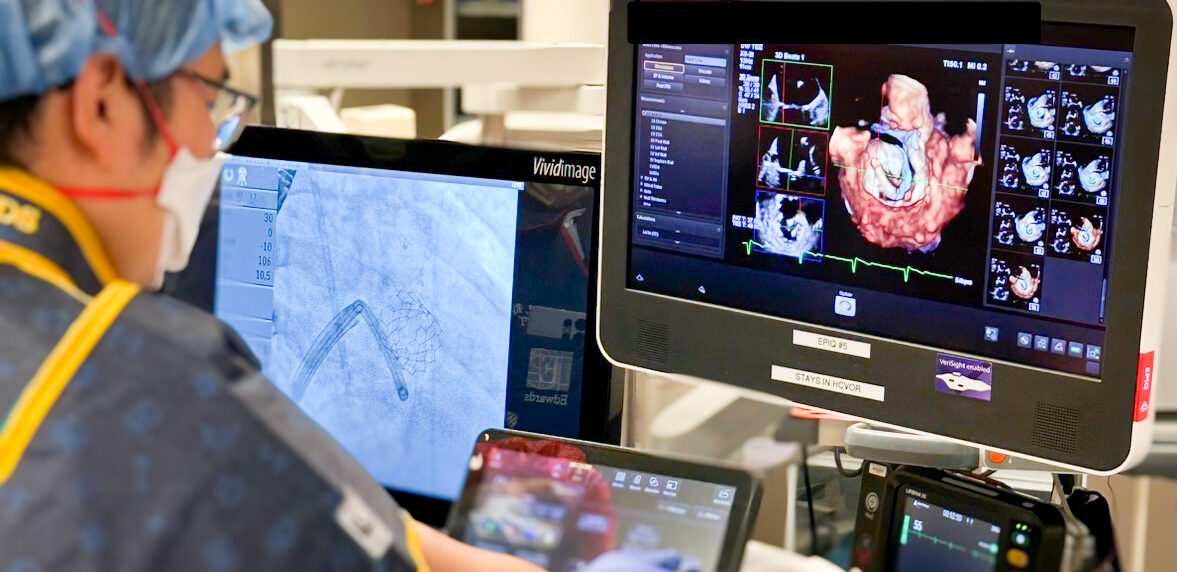
About the Interventional Echocardiography & Anesthesiology Fellowship
The Interventional Echocardiography & Anesthesiology (IEA) Fellowship is a one-year faculty fellowship based at the UW Medical Center – Montlake campus. The fellowship began at the University of Washington in 2026 and provides prospective trainees with world-class education in peri-procedural structural heart imaging and best practices in anesthetic management for transcatheter cardiovascular interventions. The program emphasizes the integration of advanced echocardiographic imaging with clinical decision-making and team-based procedural care.
We are currently accepting applications for positions on a rolling basis.
Interventional echocardiography and procedural anesthesiology are integral components of modern transcatheter structural heart interventions, contributing substantially to procedural success and patient safety.
The program’s overarching goals are to train individuals to develop advanced technical and interpretation skills in interventional echocardiography, foster sound clinical judgement and real-time decision-making in complex transcatheter procedures, and promote effective interdisciplinary collaboration within the structural heart team.
Intra-procedural echocardiographic imaging
- Fellows will gain extensive hands-on experience performing and interpreting real-time echocardiographic imaging during transcatheter structural heart procedures. Training will emphasize image optimization, procedural guidance, and early recognition of complications.
- Learners will become proficient in a variety of imaging modalities, including transesophageal (TEE), transthoracic (TTE), and intracardiac echocardiography (ICE), as appropriate to specific procedural needs.
- Instruction will focus on the practical integration of imaging findings into procedural strategy and communication within the multidisciplinary heart team.
Small group didactics and case-based learning
- Fellows will participate in faculty-led seminars covering both fundamental and advanced topics in periprocedural imaging and structural heart anesthesia.
- The curriculum will include instruction in multimodality imaging, including cardiac CT and MRI, for procedural planning and post-procedural assessment.
- Interactive case discussions will reinforce clinical reasoning, imaging interpretation, and evidence-based practice.
Quality assurance and quality improvement (QA/QI)
- Fellows will engage in faculty-mentored QA/QI initiatives aimed at advancing institutional imaging standards and patient safety.
- Projects may include image review conferences, process evaluations, or development of standardized imaging protocols for structural interventions.
Scholarship and academic development
- Fellows are expected to participate in at least two (2) scholarly activities related to transcatheter structural heart procedures. Examples include research projects, abstract submissions, manuscript preparation, curriculum design, educational content development, or presentation at local or national meetings.
- The program encourages active engagement with the broader academic community to promote innovation and disseminate best practices in interventional echocardiography and anesthesiology.
Clinical schedule
The Interventional Echocardiography and Anesthesiology Fellowship is structured as a combined clinical fellow and faculty role. In a typical week, the IEA fellow will be scheduled as follows:
- Two (2) attending clinical days in the cardiothoracic operating rooms or procedural suites at UW Medical Center – Montlake, serving as the primary anesthesiologist, supervising residents, cardiothoracic anesthesiology fellows, and nurse anesthetists. The fellow is encouraged to continue working on developing his/her teaching skills.
- Two (2) fellowship clinical days in the catheterization laboratory as the intraprocedural imager, supervised by one of the core fellowship faculty members.
- One flexible fellowship day, which the fellow may use to participate in additional intraprocedural imaging (if cases are available) or to work on scholarly activities. Fellow flex day may also be used for 1:1 imaging rounds in the cardiac CT or MRI reading rooms.
- One weekend call per month and one holiday call per year, from home, as the primary cardiothoracic anesthesiologist. There will be a secondary cardiothoracic anesthesiology attending, cardiothoracic anesthesiology fellow, and 2 residents on home call with the IEA fellow on his/her call day. There will be no other call days for the fellow.
The overall split between clinical faculty and IEA fellow time will average to 40% and 60%, respectively, over the course of the year.
Annual Stipend: We are proud to offer competitive salaries for our faculty fellowship positions.
Academic Allowance: Subject to available funding, fellows will receive an academic allowance each academic year as “all inclusive” support for their general expenses incurred during their time training.
Eligibility
Applicants must:
- Be graduates of an LCME- or AOA-accredited U.S. medical school, or an accredited Canadian medical school, or hold a valid ECFMG certificate if they are graduates of an international medical school.
- Successfully complete and graduate in good standing from an ACGME-, AOA-, or RCPSC-accredited/approved anesthesiology residency before the fellowship start date.
- Successfully complete and graduate in good standing from an ACGME-, RCPSC-, or SCA accredited/approved cardiothoracic anesthesiology fellowship before the fellowship start date. Applicants who have not completed their cardiothoracic anesthesiology fellowship by the start of the IEA fellowship are not eligible to begin training.
- Be eligible for a Washington State medical license and authorized to work in the United States.
- Pass the National Board of Echocardiography Advanced PTEeXAM® before beginning training.
Application
IEA Fellowship training program will not use any electronic application services, for example, ERAS or SF Match, for application management. Applications are instead collected via email by the program administrator and disseminated for core faculty review on a rolling-basis.
Candidates must demonstrate convincing dedication to a career in the subspecialty of cardiothoracic anesthesiology and must provide evidence of an aptitude for the subspecialty. Evidence will usually be in the form of suitable references from practicing cardiothoracic anesthesiologists who are familiar with the prospective fellow. Three letters of recommendation from faculty who have supervised the candidate, or have observed her/his practice, within the preceding year, are required. One letter of recommendation must be from the program director of the candidate’s cardiothoracic anesthesiology fellowship program.
Application documents:
- Current Curriculum Vitae
- Letter of intent/personal statement
- Three current reference letters, including one from your cardiothoracic anesthesiology fellowship program director or current director
- Copy of medical school diploma
- Copy of anesthesia degree (if applicable)
- Current medical license
- ECFMG documentation (if applicable)
Please send application and supporting documents (or questions) to Fellowship Program Director Richard Sheu.
Selection
Received applications are reviewed by the program director. Applicants will not be discriminated against on the basis of race, color, creed, religion, national origin, citizenship, sex, pregnancy, age, marital status, sexual orientation, gender identity or expression, genetic information, disability, veteran, or any other applicable legally protected status.
Invited candidates are interviewed by the program director, and by as many core cardiothoracic anesthesiology faculty as feasible. Candidates are given the opportunity to interview with the current program fellow (with the exception of the first IEA fellow) in a relaxed atmosphere without program faculty presence.
All interviewers are required to submit an online evaluation of each candidate interviewed. After conclusion of the interview process, the program director compiles a rank list based on candidate evaluations submitted by interviewers, supporting application documentation, and his personal impression of the candidate. This rank list is reviewed with the chief of cardiothoracic anesthesiology at University of Washington and other core program faculty before a final decision is made.
Candidates are selected exclusively on the basis of preparedness, ability, aptitude, academic achievement, communication skills, dedication, motivation, integrity and professionalism.
Interviews
Interview dates will be provided upon invitation. Interviews will be conducted in-person or remotely through Zoom.
Program Director: Richard Sheu, MD, FASE
Program Administrator: Nicole Baisch
A multidisciplinary, collaborative program, the Interventional Echocardiography & Anesthesiology Fellowship is led by the following faculty in the UW School of Medicine:
Cardiothoracic Anesthesiologists
Michael Hall, MD
Srdjan Jelacic, MD, FASE
G. Burkhard Mackensen, MD, PhD, FASE, FSCAI
Richard Sheu, MD, FASE
Miranda Timonen, MD
Multimodality Cardiovascular Imaging Cardiologists
Kelly Branch, MD, MS
Tiffany Chen, MD
Interventional Cardiologists
Christine Chung, MD
David Elison, MD