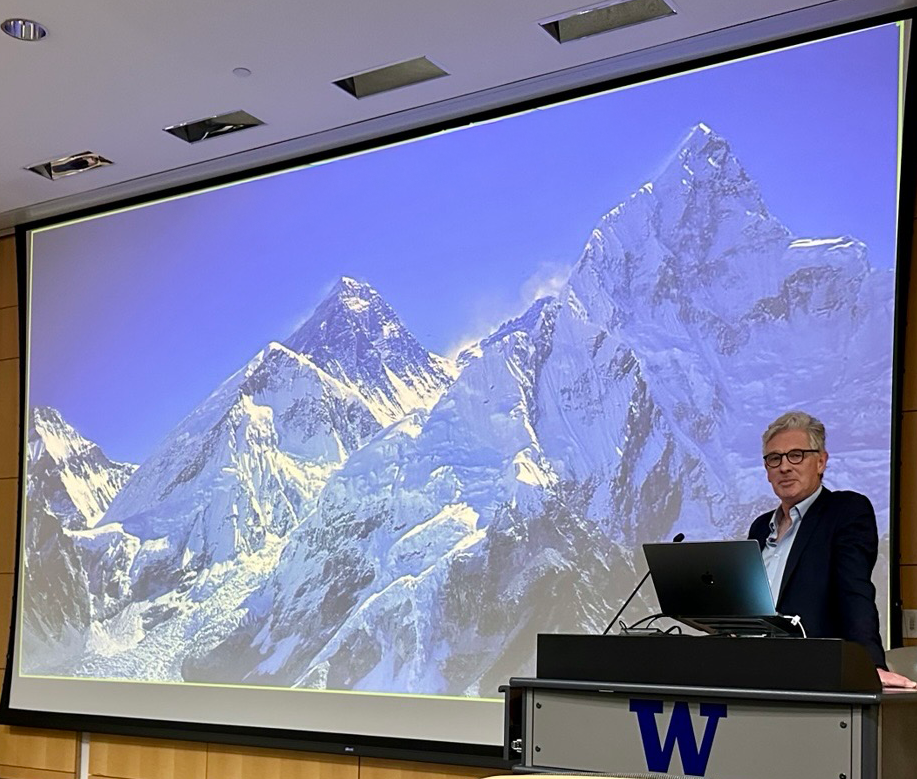
The Department of Anesthesiology & Pain Medicine welcomed Dr. Mike Grocott as the inaugural speaker for the Dr. Thomas Hornbein Endowed Memorial Lecture on March 10, honoring the legendary mountaineer, scientist, educator and former department chair.
Grocott, a professor of anesthesia and critical care medicine at the University of Southampton, summited Mt. Everest in 2007 as leader of the Caudwell Xtreme Everest medical research expedition and is the founding chair of the Xtreme Everest Oxygen Research Consortium in the UK. He delivered an inspirational talk in the Foege Auditorium to a captivated audience, interweaving expedition history, cutting-edge physiology, and the enduring legacy of Dr. Hornbein.
A deep connection to Hornbein’s legacy
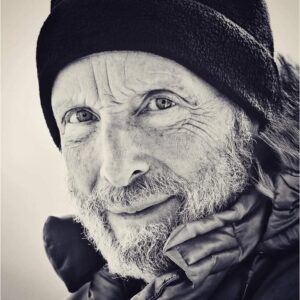
Grocott began by outlining Hornbein’s extraordinary accomplishments, particularly the famous 1963 ascent of Mount Everest’s West Ridge with partner Willi Unsoeld. Their route included climbing what is now known as the Hornbein Couloir—a narrow, steep passage high on the north face of Mount Everest, named in honor of Hornbein following this historic achievement.
As a younger man, Grocott first encountered Tom Hornbein through his book Everest: The West Ridge. Published in 1965, this seminal work chronicles the challenges of the couloir, the audacity of the route and the broader story of the expedition.
Grocott found the book so compelling it sparked a continued fascination with Mount Everest and high-altitude physiology. In the years that followed, he met Hornbein multiple times—at conferences, during collaborative writing, and even at a special anniversary event. As he recalled in the lecture, “I was fortunate enough to know [him] moderately well… he was an inspiration.” One of the signed books Hornbein gave him remains among his most treasured possessions. “I honestly cannot think of another named lecture that I would be more honored or happy to give,” Grocott said, underscoring just how deeply Hornbein shaped his scientific journey.
The intersection of research, adventure and medicine
From this historical foundation, Dr. Grocott shifted to the scientific questions that have shaped his own research career: How do humans adapt to extreme hypoxia? Why do some individuals thrive at high altitude while others struggle? And what can these insights teach us about critically ill patients who face life‑threatening oxygen deprivation?
Drawing on data from the Xtreme Everest research, which conducted one of the most comprehensive physiological studies ever performed above 8,000 meters (about 5 miles) under his leadership, Dr. Grocott described how his team transported 26 metric tonnes (28.7 U.S. tons) of scientific equipment to Everest Base Camp and established laboratories as high as the South Col, a wind-swept, frozen plateau between steep faces.
Their work included exercise physiology, microcirculatory imaging, mitochondrial assays, and even arterial blood gases collected at 8,400 meters, the highest ever obtained.
Among the team’s most striking findings: performance at high altitude is not determined by oxygen delivery alone. Even when climbers maintained near‑normal oxygen content in their blood, their exercise capacity still fell by more than a third. Instead, Dr. Grocott explained, cellular and metabolic factors—particularly microcirculatory flow and mitochondrial efficiency—play a critical role. Comparative studies with Sherpa climbers further highlighted these biological differences, revealing more efficient oxygen utilization and preserved microcirculation at extreme elevation.
These discoveries, according to Grocott, extend far beyond mountaineering. By studying healthy individuals exposed to controlled hypoxia, researchers gain insights relevant to intensive care medicine, where oxygen deprivation is a major determinant of survival. High‑altitude physiology, he suggested, offers a unique model for understanding the biology of critical illness.
An intimate glimpse into extreme science
Several close associates, mentees and admirers of Dr. Hornbein were present for the lecture, which offered an opportunity for connection and celebration at the reception that followed. Residents in attendance were awed by the introduction to Hornbein and to learn more about Grocott’s high-altitude research project.
Beyond the scientific insights, all were enthralled by the sheer visual storytelling, which included photographs of icefalls, climbers facing treacherous obstacles, portable labs powered at 6,400 meters, and the balcony on Everest.
For many, these images brought the science to life in a way no textbook could.
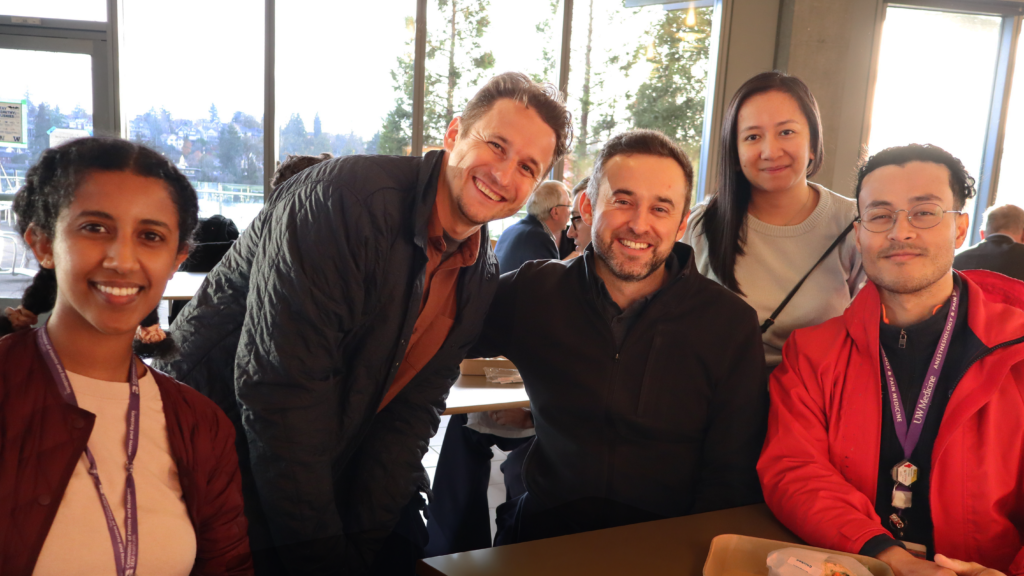
“I was really impressed,” said Dr. Rahale Getnet Tefferi, a second-year resident. “I don’t think I’ve seen a project with photographs like this showing the entire process. It opens up your mind to what you can achieve when you get people together and are willing to follow a passion like that.”
Intern Dr. Malcolm Lizzappi agreed. “I thought it was an amazing talk,” he said. “I would attend talks like that all the time if I could.”
The following morning, Grocott presented at Grand Rounds on the topic patient fitness, prehabilitation, and surgical outcomes. He also participated in an afternoon journal club to discuss recently published articles.
Reflecting upon the entire experience, Department Chair Dr. G. Burkhard Mackensen said, “Having Dr. Grocott here with us was truly special. His work sits at the intersection of science, exploration, and clinical insight, and bringing that perspective into our department made the inaugural Hornbein Lecture feel exactly as it should, both inspiring and deeply connected to our history.”
****
Dr. Grocott’s visit and lectures were made possible in part by those who have contributed to the Dr. Thomas Hornbein Endowered Memorial Fund. Kindly consider giving a gift today to sustain this meaningful annual event celebrating scholarship, adventure and research that redefines human potential.
With the approval of Dr. Grocott, a Zoom recording of the Dr. Thomas Hornbein Endowed Memorial Lecture on March 10 is available on our YouTube Channel.